From chaos to calm: infinite flow & feedback loops
How one direct piece of feedback from a content designer turned my tangled, chaotic Figma files into a genuine three-part system, chaos, calm and clarity, one I still rely on for every project. A shift that changed how every project since.
The creative process is inherently messy, by design
Screenshots thrown into a collaborative Figma document, stacked on top of one another. Sketches with notes scribbled in the margins. Half formed sentences riddled with spelling mistakes, abandoned completely, or making no sense when I come back to them later. If at all. Groups, labels, categories, corporate jargon and word-soup I haven’t quite figured out what it means or where it goes.
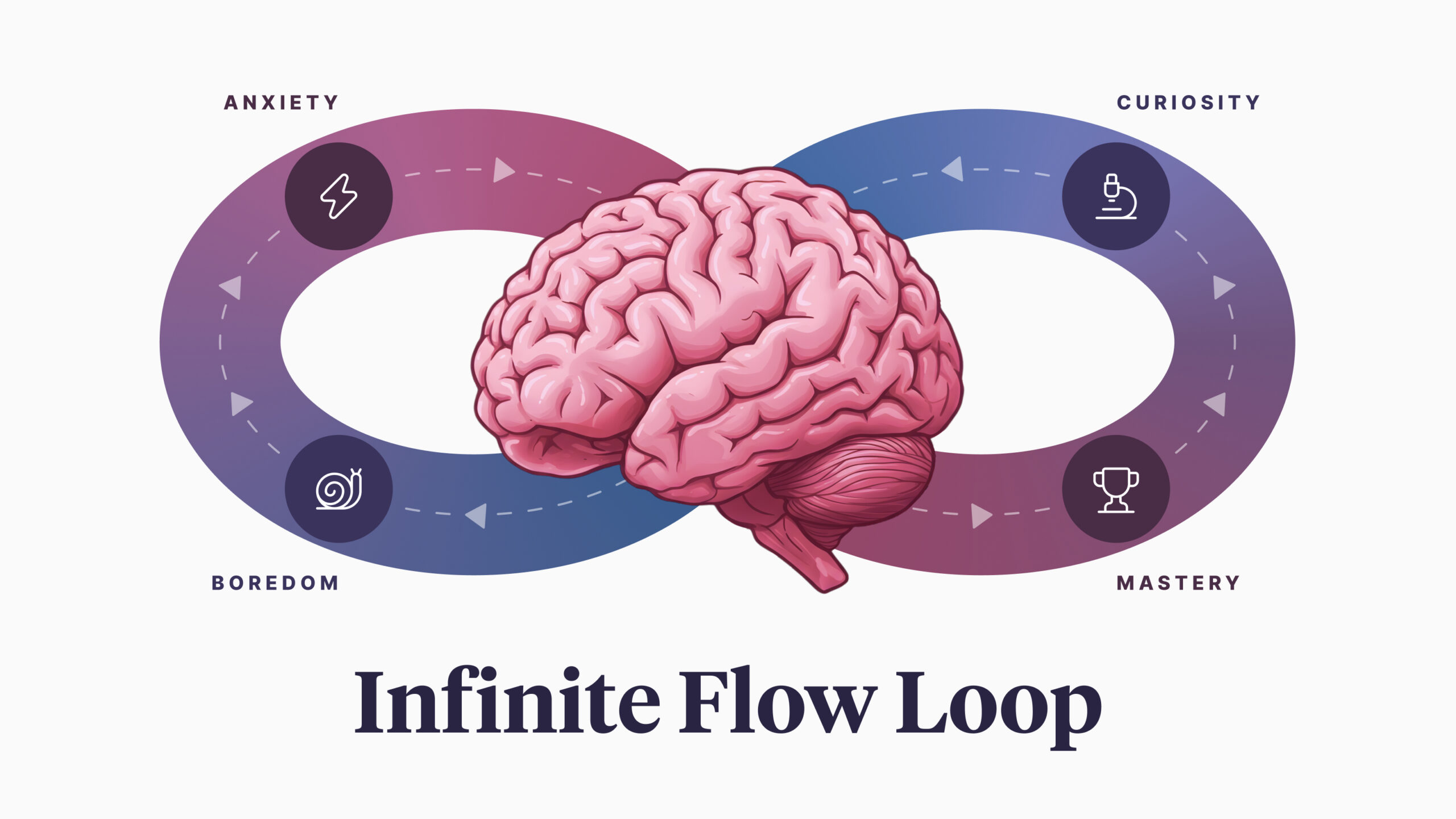
From the outside looking in, it’s an absolute state of chaos. For me, it’s a state of flow. That’s exactly why I still love being a designer after all these years, chasing that feeling of being completely locked in and fully immersed in the design process. Psychologists call it flow, or being “in the zone”. It’s an optimal state of deep focus and total immersion in what you’re doing.
This is fine if you’re the only designer on the project, less fine when you’re collaborating with others who can’t untangle the mess, let alone know where to start looking for what to focus on next. I’d just finished up a collaborative jam session when a content designer I work closely with on the project said she’d like a word. Yikes, never good.
She looked at the Figma we’d all been working on together for a couple of weeks and told me straight: it wasn’t clear what she needed to work on, or where she could help.
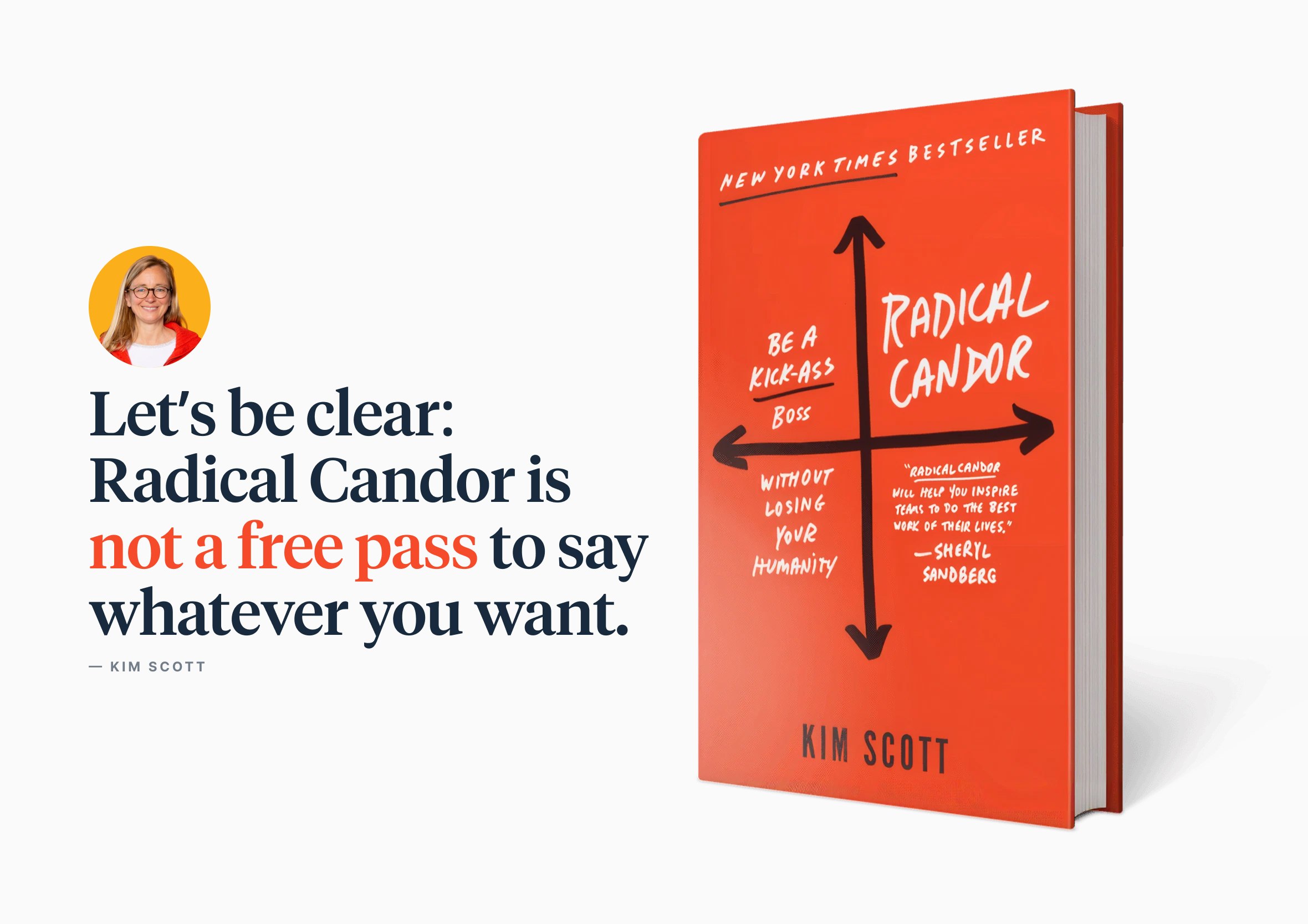
Kim Scott, on the difference between kindness and being a jerk: It’s a framework for saying what needs to be said while being kind and clear.
I take pride in my work, so I started explaining how I liked to design, and that the copy was just placeholder text for now. Then I opened my laptop to talk her through the shared Figma file, and then it hit me: “Oh, I can see how this is confusing.” Placeholder text was the least of my problems. I had art boards I’d duplicate on the fly, make some design changes, duplicate again to explore another potential direction.
⌘+C, ⌘+V, ⌘+C, ⌘+V, ⌘+C, ⌘+V, ⌘+C, ⌘+V
Nodes upon nodes, each iteration following its own path until its natural conclusion. At the time I was taken aback by her comments, yet that feeling didn’t last long. It quickly shifted into: how do I fix this so the process works for everyone?
Once you see feedback like that for what it actually is, a genuine chance to improve rather than a personal attack, it quickly stops being uncomfortable and starts being extremely useful. That night, as I reflected on her comments, I decided it was up to me to put some method to the madness.
I was convinced the answer had to be in my design file somewhere, even if it was buried layers deep. If only I knew where I’d put it. Chaos before the calm.
Speaking up, why direct feedback is a gift
Kim Scott’s book Radical Candor is where my mind kept coming back to. The idea is simple in theory yet difficult in practice: care personally, challenge directly. Honest, kind and clear feedback leaves you in no doubt, you know exactly where you stand. It’s not vague or ambiguous. It hasn’t been watered down to the stage where it loses all meaning and falls short of making any real impact or changing the outcome.
What I got that day was exactly that kind of feedback, respectfully given, no sugar coating or vague nudge in a general direction hoping I’d be able to read between the lines. Pro tip: the art of subtlety is completely lost on me.
It was delivered in a calm, relaxed tone, from someone who clearly wanted the collaboration to succeed as much as I did. It could easily have been misinterpreted as a character assassination. It wasn’t one, it was an opportunity and invitation to improve, and framing it that way changed the whole conversation.
Of course someone who writes for a living, and who’d previously worked as a journalist at a well-known international broadcaster, was going to have a great command of the English language.
She could have chosen not to speak up, staying quiet rather than having a difficult conversation. Or worse, she could have gone the other way and hedged everything so carefully that the real point never actually landed, the kind of feedback that feels kind in the room and achieves nothing once you walk out of it. Radical Candor has a name for that particular trap: ruinous empathy.
Her directness only worked because both people trust it comes from a place of kindness and support. Once you’ve had it once, it becomes the new way of working. At the end of the conversation, I thanked her and said, “Leave it with me, I’ll have a think and come back to you with some ideas soon.”
The design squiggle
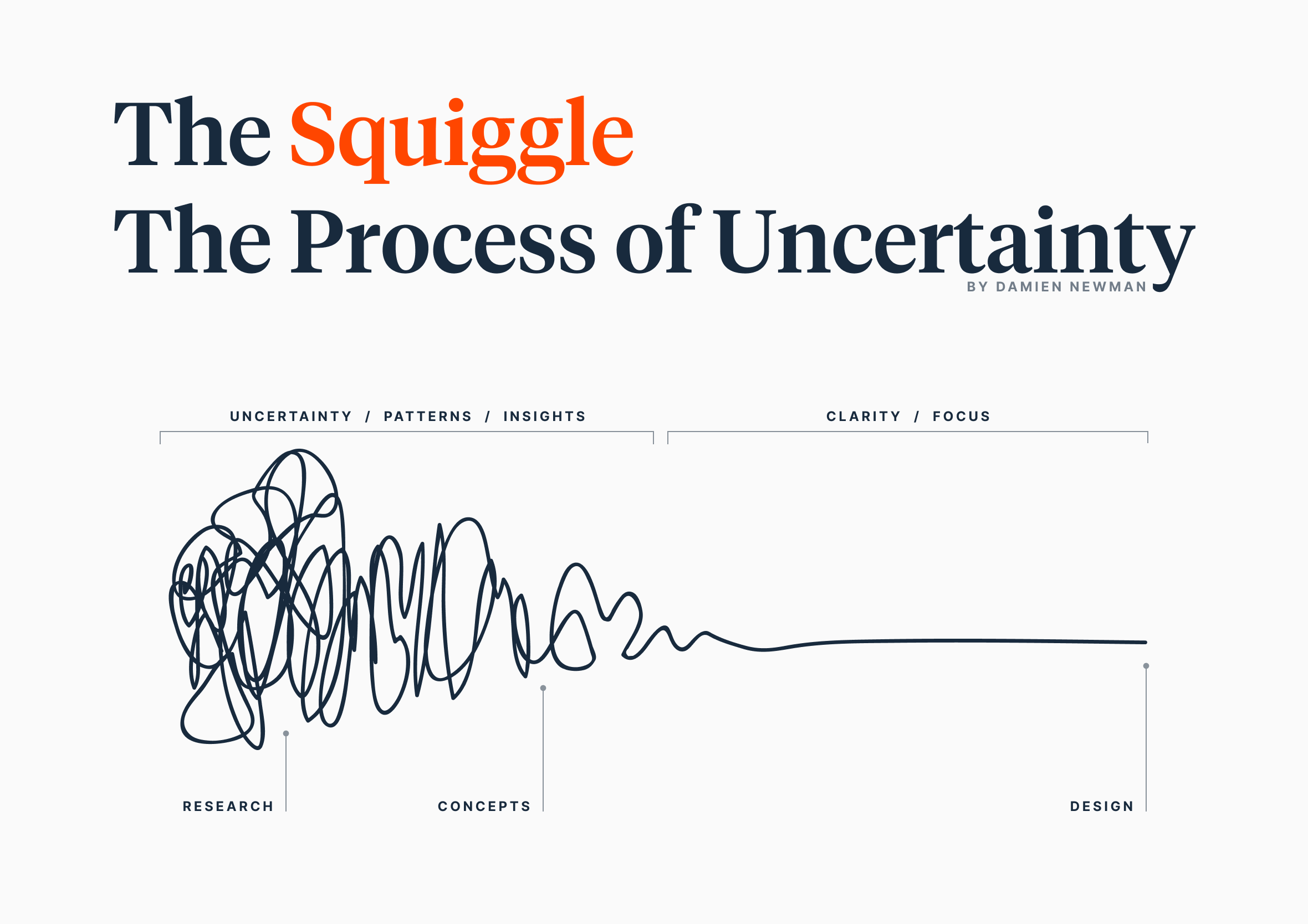
You might already know Damien Newman’s Design Squiggle, I’ve written about it before, a scribbled line that starts as total chaos and gradually settles into a single clear point. It’s not really a process model. It’s more an image I’ve started to show people so they know what to expect straight out the gate. What I love about this image is how elegantly it explains the process. Simplicity really is the ultimate sophistication.
Damien sketched the first version in the early nineties while working as an illustrator at Xerox, the company that gave the world the personal computer and the user interface. A few years later, he needed to convince a client the mess up front was a process worth trusting, and they gave him just thirty seconds to make the case. So he sketched a handful of squiggly lines and used the best one to make his point. A colleague at IDEO later found it and used it for an intern T-shirt, which is when Damien released it publicly under Creative Commons for anyone to use, with credit.
Damien Newman’s “The Squiggle” or as I like to call it the chaos before the calm.
I use it for the exact same reason he did. It sets the expectation that research and concept work feels uncertain and slow before anything looks like a finished design. Chaos before the calm, and that’s exactly as it should be.
I wish I’d found this illustration back in 2016, when I was working on a complex government work for ACC. It would have helped explain we were still very much in the research phase, and that it would get us to clarity and focus with more confidence, and a lot faster.
At my last role, I was the only designer on the project I was assigned to, so working at pace became my flow to consistently hit deadlines and stay ahead of the engineers. Once the dust had settled, I’d pull concepts, screen flows and interactions into a structured format before every design walkthrough or a stakeholder presentation.
That instinct, work fast and messy first, then translate it into something clear, is exactly what carried over into how our team works today. The previous stage was loose concepts, interactions and ideas. Now, it’s the real tangible designs we can take into meetings to have conversations about what we’re going to build. Here’s what that looks like in practice.
Building the three-part collaboration workflow into Figma
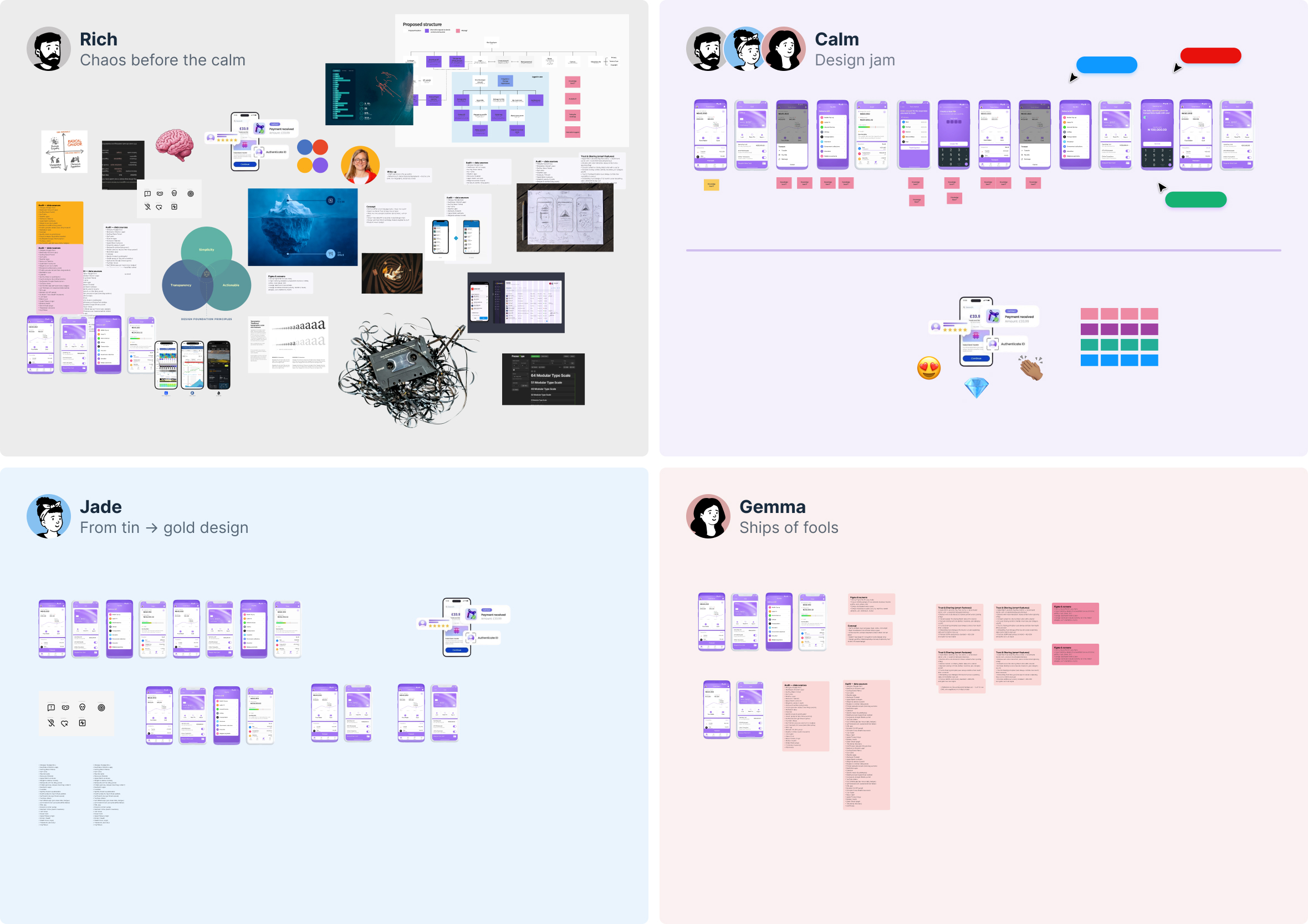
There are six of us on the team altogether, split across two inter-related projects, and the three of us on this one settled into a system that starts with Chaos, the same systems thinking prototyping instinct applied to a different kind of project. Everyone gets their own dedicated space in Figma to concept freely in the open with little concern for getting it right on the first attempt. It all lives on the same shared page, so the rest of the team can see what everyone’s working on, even if no one’s touching it yet.
Once an idea has enough shape to share, it moves into Calm. We set up two dedicated areas here, one for content to finesse the words and structure the information. Another for UX/UI to work through interactions, flows, and components. From there we’d leave comments, riff on each other’s ideas, or grab a shared desk or jump on a video call to talk it through, whatever got us to a shared understanding fastest.
Three individual chaos boards (mine’s genuinely called Chaos before the calm) feeding into one shared Calm section.
We kept a decision history alongside a design graveyard too, in case our thinking changed and we needed to revisit an old direction after feedback from a stakeholder or a round of usability testing. Digital minimalism doesn’t come naturally to me here. I’ve learned over the years to hang on to everything, because a half-baked design from three weeks ago might be exactly the piece you need to Frankenstein together something elegant later. Rise of the phoenix, from the ashes of a dozen half-finished ideas.
Once the three of us were aligned, screens moved to an entirely new page called “Ready to present”, the clean version, ready to present to stakeholders without a trace of the mess that got us there. Unless they want to see the exploration that led us here, in which case, before we show them, it comes with a disclaimer: “This is chaos mode.”
Building your own chaos before the calm
When I pitched my idea to the team I wanted it to feel collaborative rather than prescriptive. So I checked in through the walkthrough to make sure it actually worked for everyone, not just myself. A few minor tweaks later, it was streamlined enough that all three of us now use this approach daily. I even got a shout out for putting it together.
You don’t need Figma specifically for any of this to work. The principle holds up regardless of software. Give everyone a dedicated space to work things out, then a separate collaborative space to get clear and work together. The tool matters less than the boundary between the two.
None of this would exist without one moment of direct feedback, delivered with care, that I could have easily brushed off or taken personally. Instead it became the thing that changed how three designers actually work together. That’s the part worth remembering more than the Figma structure itself. If there’s mess in your own process right now, that’s not a sign something’s wrong. It’s usually a sign you’re still in the research and concept stage, exactly where the squiggle says you should be. The trick isn’t avoiding the chaos. It’s building a natural place for the calm to live.
Finding the right words to say thank you
I’ve always struggled with words, English has never really come naturally to me. It takes concentration and focus just to stay on track. Throw ADHD and dyslexia into the mix, the same neurodiversity and reflection that shapes how I’m wired, and things can go sideways quickly, unless you put systems in place.
“Writing is rewriting” is a maxim popularized by authors like Ernest Hemingway, and this article proved it more than most: numerous rewrites, the same AI partnership and writing process with Claude AI assisting with proofreading and editing, text to speech read back to hear my own words out loud. Even getting the lawyers involved.
Disclaimer: Ali, my wife, is an actual lawyer, so it’s less a legal review and more a case of “Hey babe, can you take a quick read of this, please?”
With that said, given the content designer’s love of words, investing the time in writing this article felt like a more meaningful way to put in the work and give my genuine thanks.