• Written by Rich McNabb • Proofread & Edited by Claude AI
How one wrong booking ended up with five cards on the table
Everyone has values. Few people can name their core values. Here's how I found mine, and why I wished I'd done it sooner.


• Written by Rich McNabb • Proofread & Edited by Claude AI
Everyone has values. Few people can name their core values. Here's how I found mine, and why I wished I'd done it sooner.

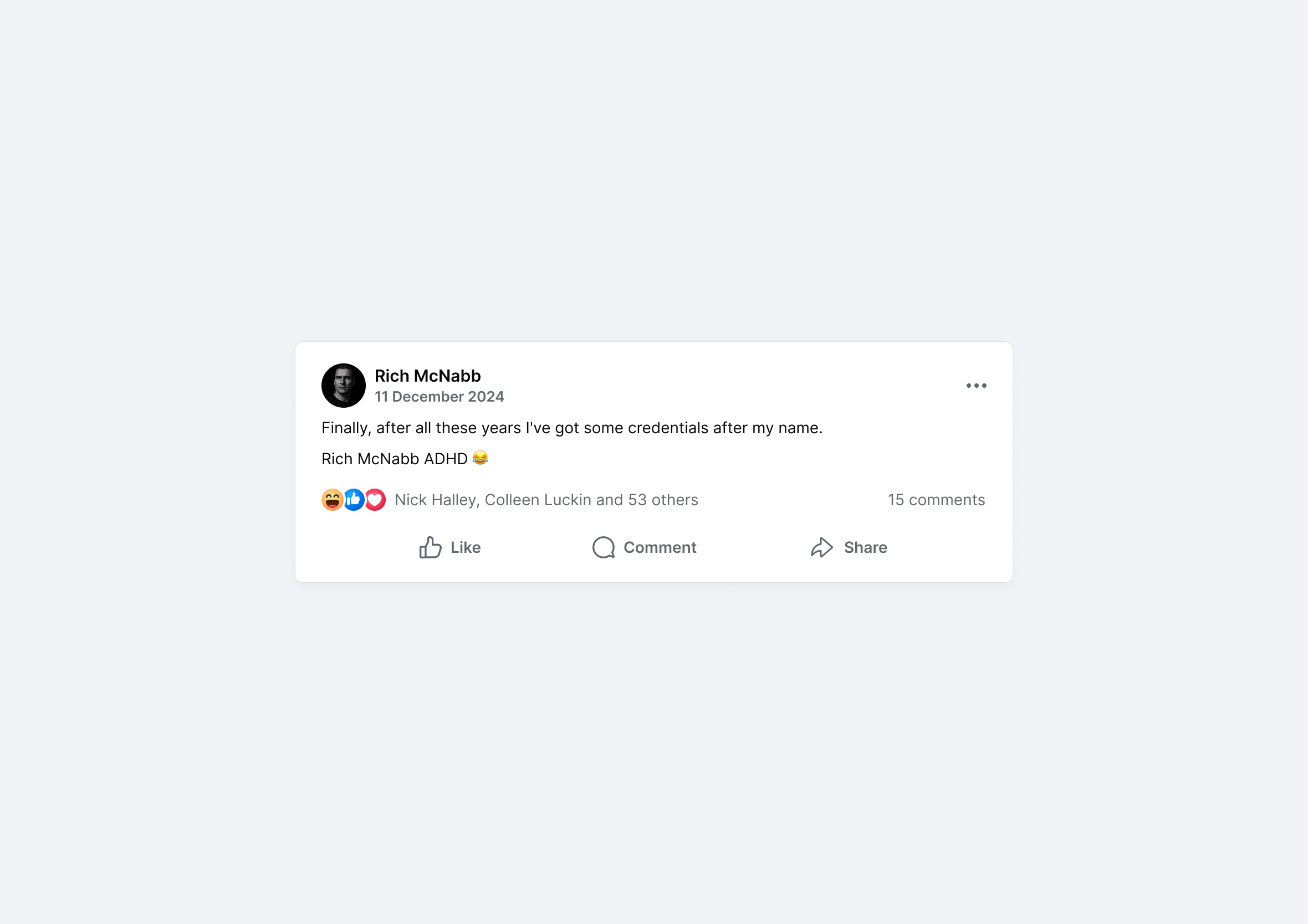
I was formally diagnosed with ADHD on Wednesday, 11 December 2024.
My daughter had recently been diagnosed with ADHD. Symptoms, behaviours, developmental milestones, and personality traits suddenly made more sense, all the pieces seemed to fall into place. My wife and I started to see her in a different light and understand her more. In hindsight it was obvious, yet the famous sentiment with hindsight is that it always turns up late.
Given my daughter and I share a lot of the same personality traits, I thought it made sense to get some tests done. When I told people I had been diagnosed with ADHD, the overwhelming response was “Sorry Rich, we thought you knew already.” Classic Rich, always late to the party and last to know.
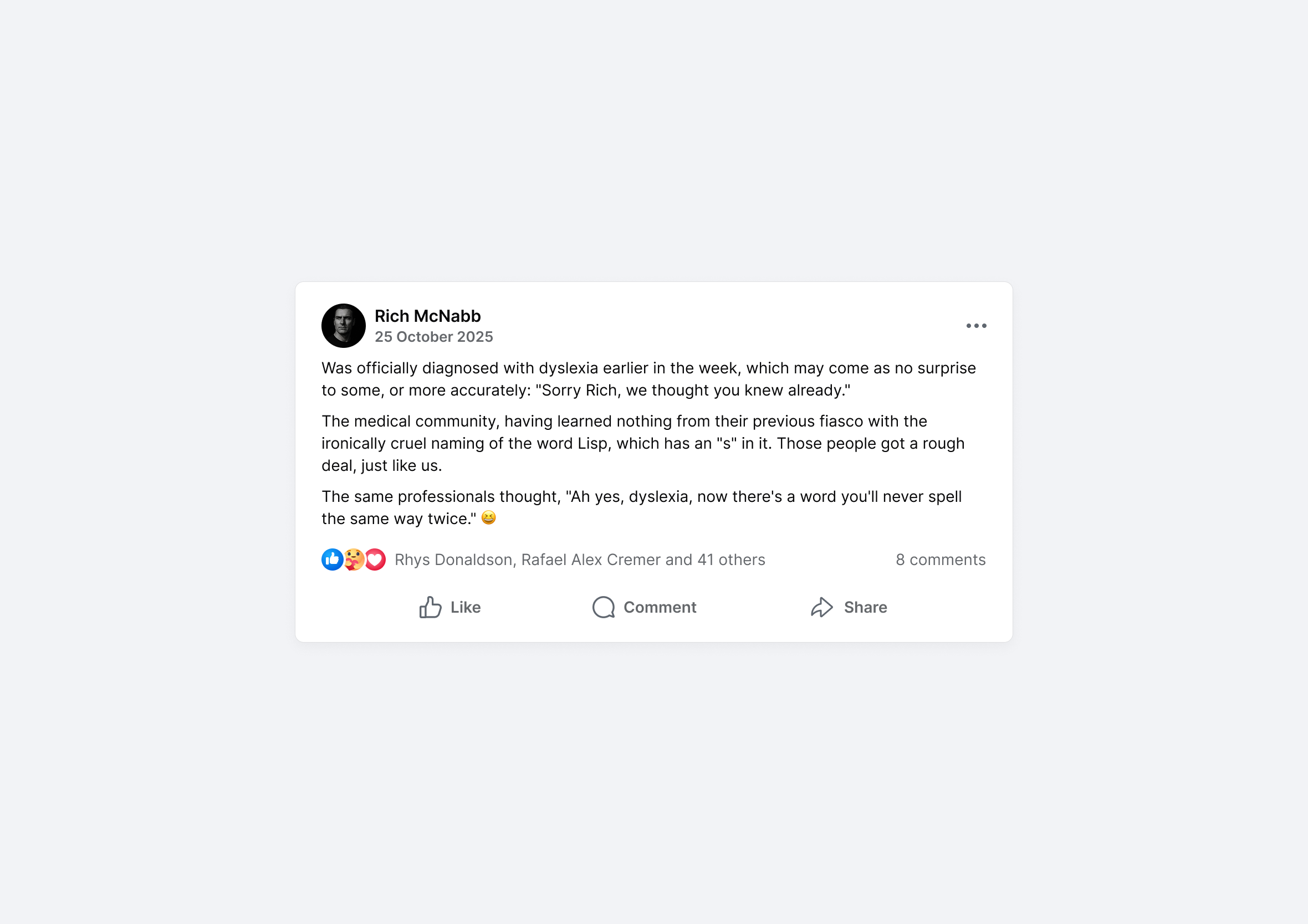
About a year later my daughter was diagnosed with dyslexia. After doing some research I discovered that if you have ADHD, there’s a higher probability you will also have dyslexia. At the time I was 46 years old and thought to myself, what’s the point? I’ve made it this far and seem to be doing okay. But figured since I could claim it under health insurance, what’s the worst that could happen.
On Thursday, 23 October 2025 I was formally diagnosed with dyslexia. My doctor recommended I start working with an ADHD coach after being diagnosed as an adult.
TL;DR – Dyslexic friendly:
At work we have access to an EAP (Employee Assistance Programme) which provides access to Modern Health, an online mental health care platform. I went onto the Modern Health website, created an account, found someone who looked perfect and booked a session for the following week.
All done in a matter of minutes.

The day of my appointment arrives. A few minutes beforehand I update Zoom, test the video and audio, and join the meeting. Equal parts excited and nervous if I’m being honest. She joins the meeting, we say hello, and she calmly asks, “What brings you here today?” I explain that I’d been diagnosed with both ADHD and dyslexia and my doctor had recommended working with a coach.
And that’s when she explained she wasn’t a coach.
She was a psychologist.
For anyone who gets these terms mixed up like I do, a psychologist uses conversational therapy to help you work through things, a psychiatrist does the same but can also prescribe medication, and a coach works with you on goals and strategies. Three different approaches, easy to mix up.
It took a while to build up the courage to book that first appointment. I figured I might as well make the most of it and we started chatting. Another “what’s the worst that could happen?” moment. Growing up in the 80s, talking about mental health wasn’t really a thing. You got on with it and kept things to yourself. These days I see things differently. There’s real strength in being open and vulnerable. It leads to better conversations, better relationships and, in my case, a much better understanding of myself.
And it turned out to be one of the best decisions I didn’t actually make. During those early sessions we talked about a wide range of topics, but one conversation really stood out. It was about values.
During the values session we talked about how they provide direction and whether I knew what mine were. I knew I had values but had never really put a name to them, or grouped them in a way that made sense.
She introduced me to Think2Perform’s Values Cards, a core values exercise designed to help you identify what matters most. She gave me a brief walkthrough of how it works and asked me to complete it before our next session.
The goal was simple: identify your values so you can start living in alignment with them.
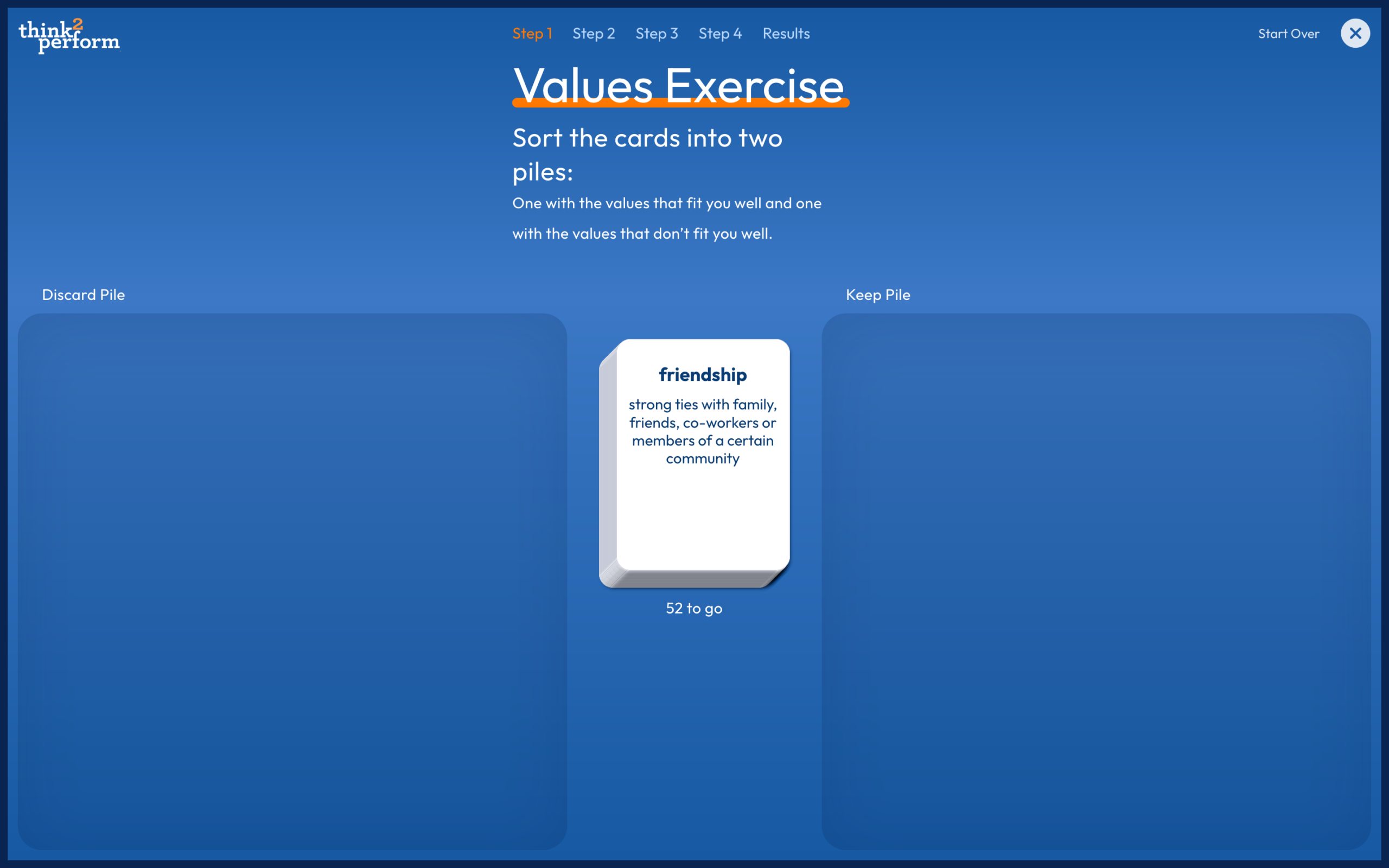
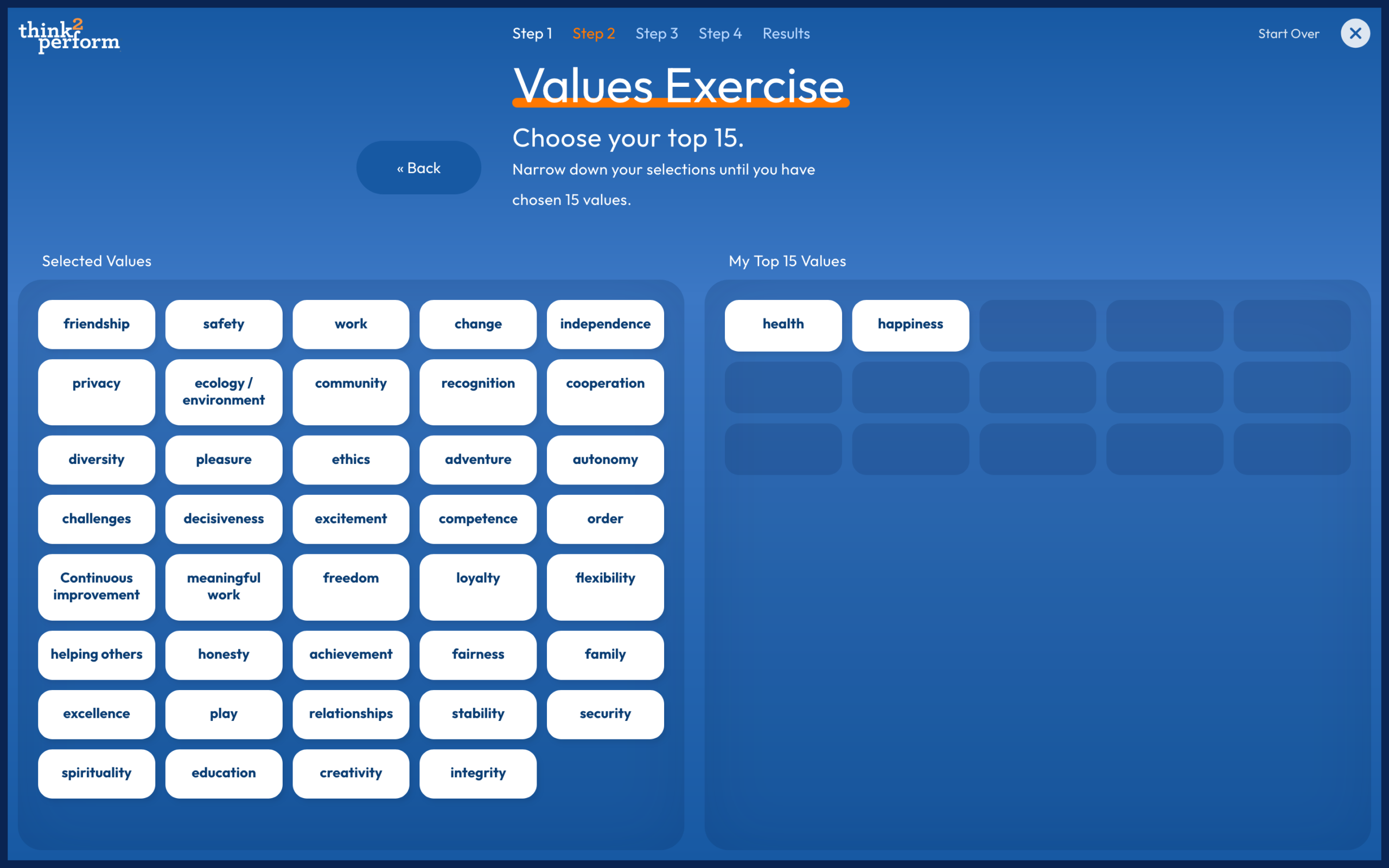

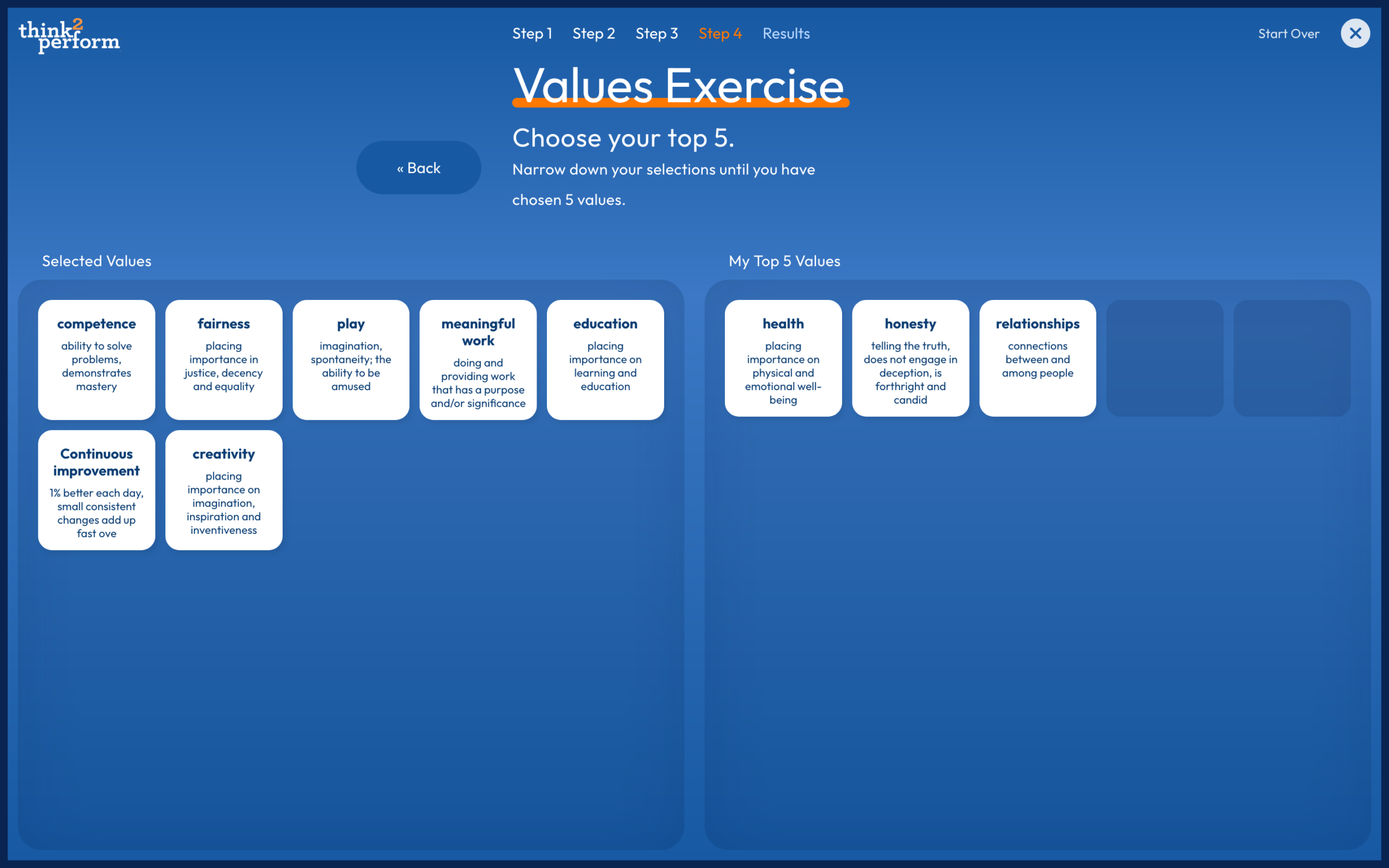
Four rounds, each one narrowing the field. By round three, the purpose of the exercise becomes very real, very quickly.
There are four rounds, with each round getting harder:
I understand the game mechanics and, for simplicity, the terms make sense. However, Keep and Discard feel at odds with the spirit of the exercise. It’s not like you’re discarding the two of spades in a poker game. Discarding adventure doesn’t mean you’re opposed to having a good time. It means when you have to choose between adventure and health, health won. Every time.
Forcing your hand is the whole point. It surfaces what you actually prioritise, what resonates, not what you think sounds good.

With my top five core values in front of me, things become clearer. I think for the most part I do a pretty good job of incorporating them into my daily life. Think2Perform provides definitions for each.
Here’s what they actually mean to me:

1. Health
At least 30 minutes of exercise each day.

2. Honesty
The truth always catches up with you. Plus I’m not smart enough to remember anything but the truth.

3. Relationships
Forming strong professional and personal connections with people.

4. Creativity
Coming up with imaginative and inventive approaches to solve problems.

5. Continuous improvement
1% better each day, small consistent changes add up fast over time.
Worth remembering that some days these come easier than others, based on your mood and energy levels. Health could be as intense as a high energy 3-hour surf or like that time I poured 2 cups of coffee into my yeti to drink on the treadmill at the gym while watching a Mastodon documentary.
Doesn’t get much more rock ‘n roll than that 😂🔥🤘
Self-awareness doesn’t happen by accident. It takes time, a bit of reflection, and sometimes the willingness to have conversations you’d normally avoid. As a parent, that became increasingly important to me. I couldn’t be a dad and tell my kids it’s okay to talk about their feelings without taking my own advice and leading by example.
That accidental appointment and the conversations that followed helped me understand myself more clearly. Not who I thought I should be, but who I actually am. Those five cards reflected decisions I’d already been making. The exercise didn’t tell me who I was. It just helped me see it more clearly.
If you’re curious about how I’m wired more broadly, I also wrote about my ENFJ and CliftonStrengths results.
One thing worth mentioning, about a year before this experience, I met with a counsellor whose advice was sound, but felt too academic and never quite landed for me. To be clear, that’s by no means a reflection on them, more that they weren’t the right fit for me personally.
Keep going until you find someone you connect with. This honestly makes all the difference.
Yes, after six sessions with a psychologist I booked into work with a coach.
Turns out you needed both! The coaching and therapy sessions complemented each other and covered a range of topics, some interesting conversations and different approaches. These were just a handful of tools we used throughout, and it was something I genuinely looked forward to each week.
My coach introduced me to the idea of Tiny Habits, a concept from BJ Fogg. The idea is simple. Make the first step so small it feels almost too easy to skip.
Instead of focusing on finishing a task, you focus on starting it. Not a plan or a system. Just the smallest possible physical action that gets you moving.
I had 50 frames sitting in storage. Months went by and I kept meaning to get started on the gallery wall. She suggested leaving a single frame by the office door.
Within the week, the frames were out of storage and, a few weekends later, I had four metre album wall. It still surprises me that something so small worked. One frame was all it took to get me started.
With both diagnoses I tried to find the silver lining. I made a point of sharing openly with friends and colleagues to normalise talking about mental health. The response was overwhelming. So many people messaged privately to say thanks for posting, or to ask questions.
Looking back, those conversations probably shouldn’t have surprised me. They reflected many of the same values that ended up on my final five.